
Plate heat exchangers are highly efficient heat transfer machine widely used in HVAC systems, food processing, refrigeration, chemical industries, and energy recovery applications. Instead of using large tubes or bulky shells, these units exchange heat through a stack of thin corrugated metal plates arranged closely together.
Compared with traditional shell and tube heat exchanger, this design offers a much larger heat transfer surface area in a compact space. That is why modern industrial systems increasingly prefer this technology for heating, cooling, condensation, and temperature control applications.
As a factory with more than 10 years of experience manufacturing PHE plate heat exchangers, plates, and gaskets, senovis have worked with customers from HVAC, marine, food, and industrial sectors worldwide. Our products are manufactured according to ISO and CE standards to ensure reliable quality and stable thermal performance.
What are Plate Heat Exchangers and How Do They Work?
Two fluids with different temperatures flow through separate channels inside the equipment. One side carries the hot medium, while the other carries the cold medium. Heat transfers through the thin metal plates without the two fluids mixing together.
Most systems use a counterflow arrangement because it improves thermal efficiency. In this design, the hot and cold fluids move in opposite directions, allowing more effective heat transfer throughout the entire plate pack.
The corrugated pattern pressed into each plate is another important feature. These wave shaped patterns create turbulence inside the flow channels. Turbulent flow helps break up boundary layers and significantly improves heat transfer performance, often making these systems several times more efficient than traditional designs.
Because the plates are very thin, heat can move quickly from one side to the other. This allows compact equipment to achieve excellent thermal performance while occupying much less installation space.
📌 Schematic diagram displays
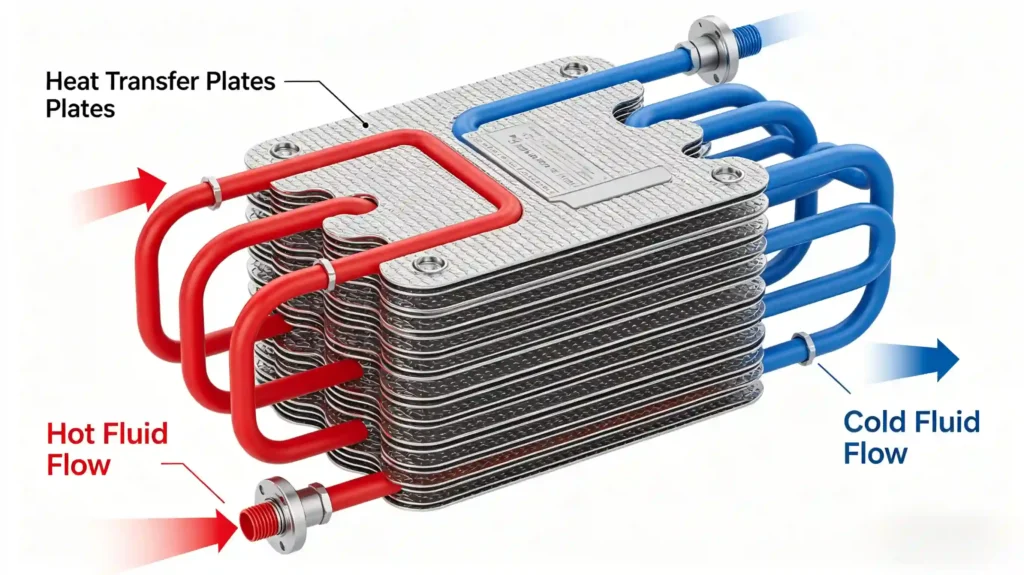
Main Components of a Plate Heat Exchanger
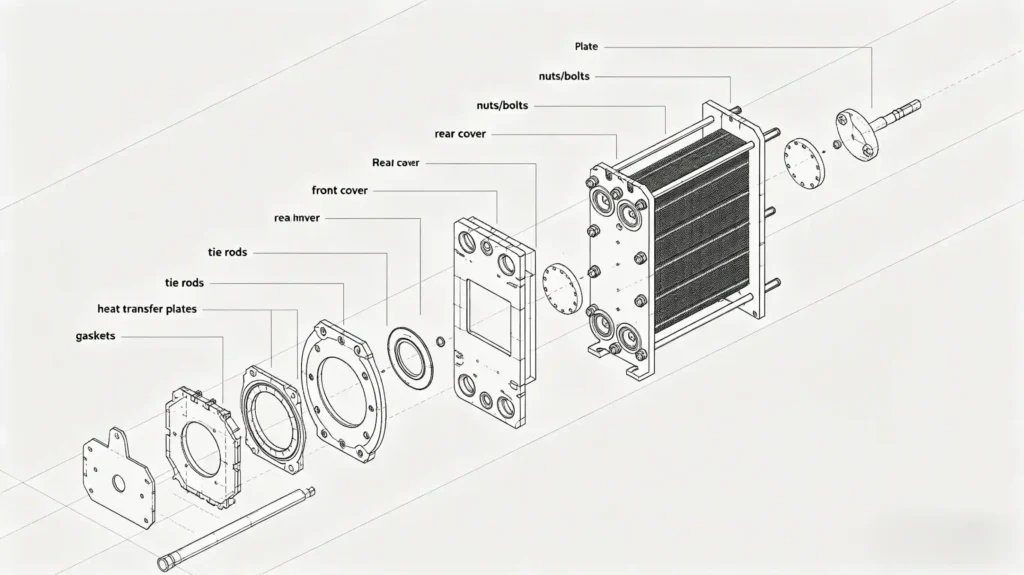
Although designs vary depending on the application, most units contain several key components.
Heat Transfer Plates
The plates are the core part of the system. They are usually made from stainless steel or titanium and pressed into corrugated patterns to improve turbulence and heat transfer efficiency.Different plate patterns are designed for different operating conditions. Some are optimized for high efficiency, while others focus on reducing pressure drop.
Gaskets
In gasketed models, elastomer gaskets seal the plates and separate the flow channels. These gaskets prevent leakage and ensure the two fluids remain isolated.Different gasket materials are selected according to temperature, pressure, and chemical compatibility requirements.
Frame and Tightening Bolts
The frame holds the plate pack together under pressure. Tightening bolts compress the plates and maintain proper sealing between channels.
Ports and Connections
Ports allow fluids to enter and exit the exchanger. Proper connection design helps ensure balanced flow distribution across the plate pack.
📌 Plate Heat Exchanger Parts Exploded View
Types of Plate Heat Exchangers
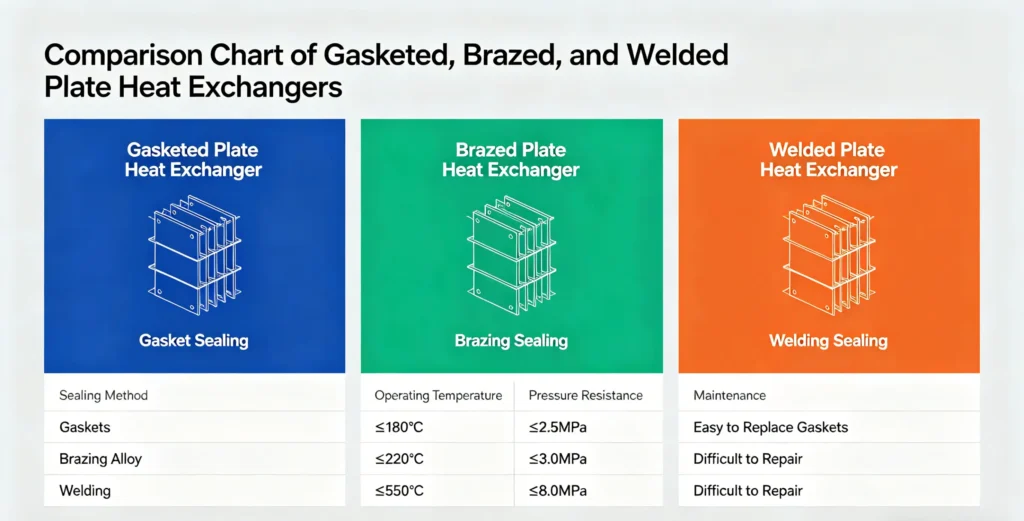
The three most common categories are gasketed, brazed, and welded systems.
Gasketed Plate Heat Exchangers
These models use replaceable gaskets between the plates. One major advantage is easy maintenance because the unit can be opened for cleaning, inspection, or capacity expansion.
This type is widely used in:
- HVAC systems
- Water-to-water heat transfer
- Food processing
- Industrial heating and cooling
Because the plate pack can be expanded, gasketed systems are also suitable for future capacity upgrades.
Brazed Plate Heat Exchangers
Brazed units do not use gaskets. Instead, the plates are permanently joined using copper or nickel brazing materials. This compact design allows the equipment to handle higher pressures and temperatures while reducing maintenance requirements.
Brazed units are commonly used in:
- Refrigeration systems
- Heat pumps
- Boilers
- Chiller applications
Due to their compact structure, they are especially popular in installations with limited space.
Welded Plate Heat Exchangers
Welded models are designed for aggressive fluids and demanding industrial environments. Instead of gaskets, the plates are welded together to improve chemical resistance and pressure capability.
These units are often found in:
- Chemical plants
- Petrochemical industries
- Energy recovery systems
📌 Differences between gasketed, brazed and welded plate heat exchanger models
Advantages of Plate Heat Exchangers
One reason these systems have become so popular is their combination of efficiency, compactness, and flexibility.
Compact Design
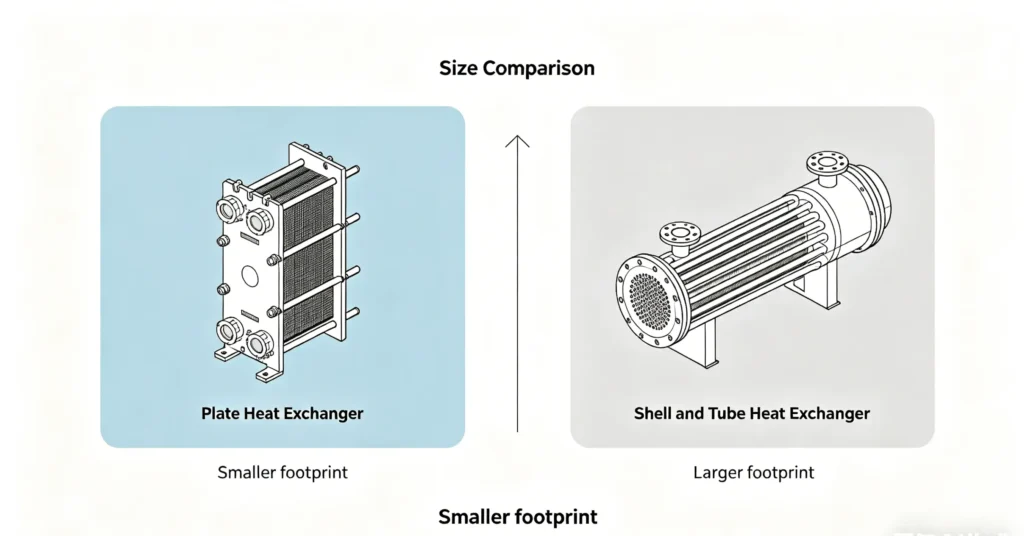
Compared with traditional shell and tube systems, these units can often achieve similar thermal performance while occupying significantly less space.
In many HVAC and industrial projects, reducing installation footprint is extremely important.
High Heat Transfer Efficiency
The corrugated plates create strong turbulence, which greatly improves heat transfer performance.
This means:
- Faster heating and cooling
- Lower energy consumption
- Improved temperature control
Easy Maintenance
Gasketed systems can be opened for inspection and cleaning, making maintenance much easier than many traditional heat exchangers.
If a plate becomes damaged, it can often be replaced individually instead of replacing the entire unit.
Flexible Capacity Expansion
Many gasketed designs allow additional plates to be added later. This modular structure makes future system expansion more convenient.
Energy Savings
Higher efficiency usually means lower operating costs. Improved heat recovery can significantly reduce energy consumption in industrial systems.
📌 size and space occupation comparison
What are Plate Heat Exchangers Used For?
These systems are used across many industries because they provide efficient temperature control in compact spaces.
HVAC Systems
- Chilled water systems
- Boiler separation
- Heat pumps
- District heating
Food and Beverage Industry
Sanitary designs are widely used in:
- Milk pasteurization
- Beverage production
- Brewing systems
Stainless steel plates help maintain hygienic processing conditions.
Chemical Processing
Chemical industries often require corrosion-resistant materials such as titanium or specialized stainless steel grades.
These systems are used for:
- Process cooling
- Chemical heating
- Solvent recovery
Energy Recovery Systems
Many industrial facilities recover waste heat to improve energy efficiency. Plate exchangers are commonly used to transfer heat from exhaust streams or process fluids back into the system.
📌 Common industry scenarios
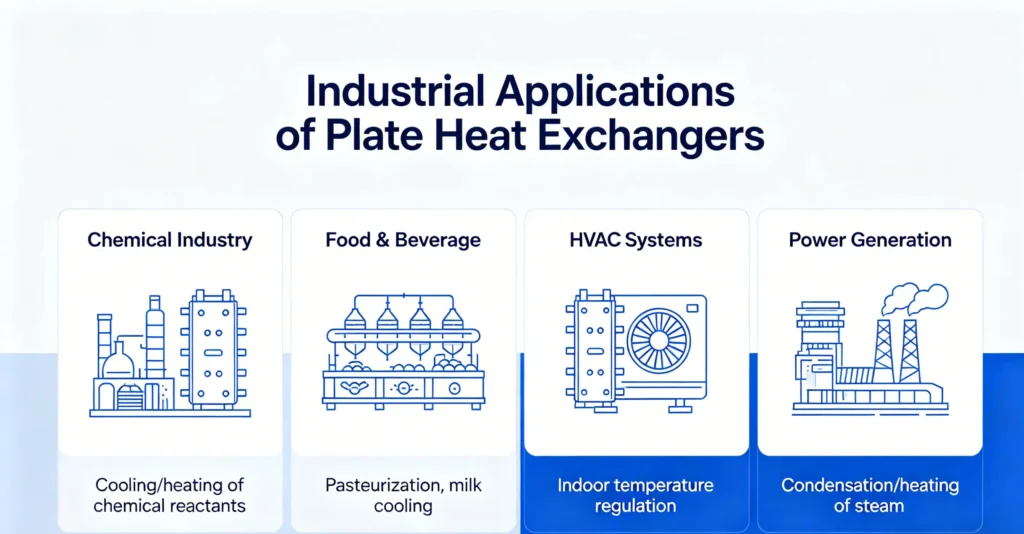
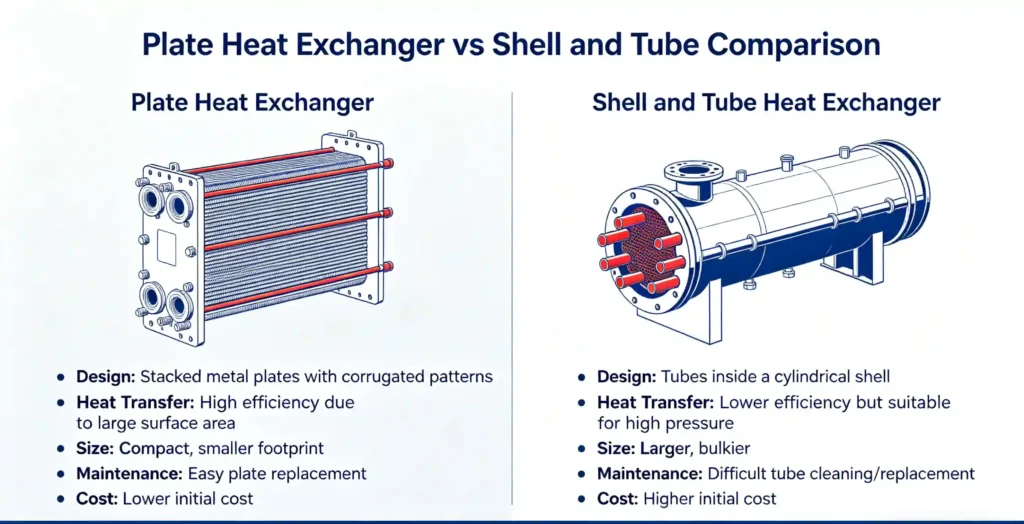
Plate Heat Exchanger vs Shell and Tube Heat Exchanger
Both technologies are widely used, but each has different strengths.
Shell and tube systems are known for handling extremely high pressures and dirty fluids. However, they are usually much larger and less efficient in compact installations.
Plate-style systems generally offer:
- Higher heat transfer efficiency
- Smaller footprint
- Easier maintenance
- Lower energy consumption
For many HVAC and clean-fluid applications, plate technology has become the preferred choice.
📌 Core performance and structural differences
Conclusion
PHEs have become one of the most efficient and compact solutions for industrial heat transfer. Their high efficiency, flexible structure, and space-saving design make them suitable for HVAC, refrigeration, food processing, chemical industries, and energy recovery systems.
With more than 10 years of manufacturing experience in heat exchangers, plates, and gaskets, we understand the importance of reliable thermal performance and long-term durability. Our products are manufactured according to ISO and CE standards and are designed to meet the requirements of various industrial applications worldwide.
If you need technical support, replacement plates, gasket solutions, or assistance selecting the right heat exchanger for your system, feel free to contact our team for professional support.
