
Choosing the correct plate heat exchanger size is critical for achieving efficient heat transfer, stable temperatures, and long equipment life. Whether you are designing an HVAC system, industrial cooling process, radiant floor heating system, or boiler application, selecting the wrong size can lead to poor performance, excessive pressure drop, energy waste, and even equipment failure.In this guide, we explain how plate heat exchanger sizing works, the key factors engineers consider, and how to estimate the correct size for your application.
Why Proper Plate Heat Exchanger Sizing Matters
Selecting the correct size is one of the most important steps when designing a heat transfer system. A properly sized plate heat exchanger improves thermal efficiency while reducing operating costs and maintenance problems.
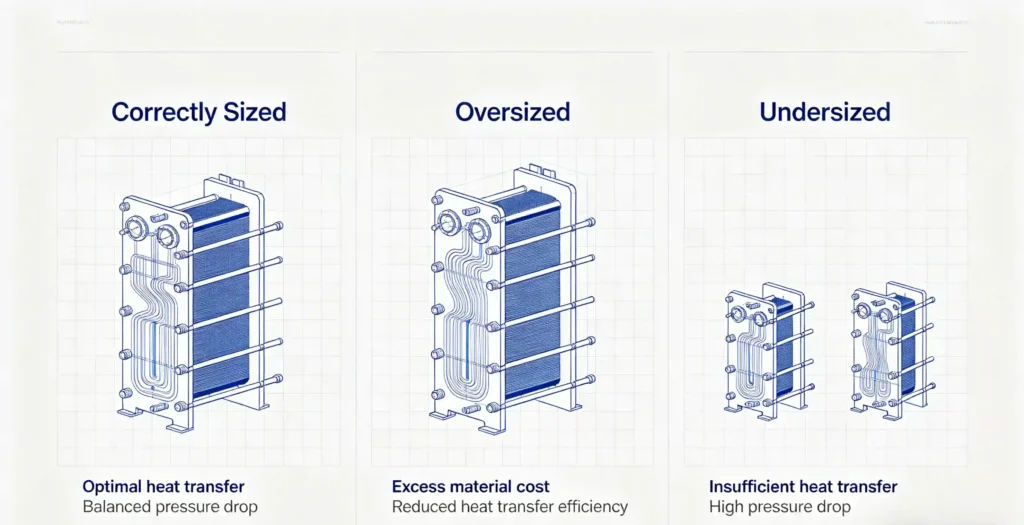
How Incorrect Sizing Reduces Heat Transfer Efficiency
When a heat exchanger is not correctly sized, the system may struggle to transfer enough heat between fluids. This often results in unstable outlet temperatures and reduced overall efficiency.
An undersized heat exchanger typically cannot handle the required thermal load, while an oversized unit may operate inefficiently under partial load conditions.
Common Problems Caused by Oversized Heat Exchangers
Oversized units may seem safer, but they often create unnecessary problems:
- Higher equipment costs
- Larger installation space requirements
- Reduced flow velocity
- Lower thermal efficiency
- Increased maintenance costs
What Happens When a Plate Heat Exchanger Is Too Small
If the unit is too small, common issues include:
- Poor heat transfer
- High pressure drop
- Temperature instability
- Reduced heating or cooling performance
- Shortened equipment lifespan
Why Accurate Sizing Helps Reduce Energy Costs
Proper sizing allows the heat exchanger to operate within its ideal thermal range. This improves energy efficiency and helps reduce pump and operating costs over time.
📌 Suggested Image Placement
Getting Plate Heat Exchanger Sizing Right: Key Factors
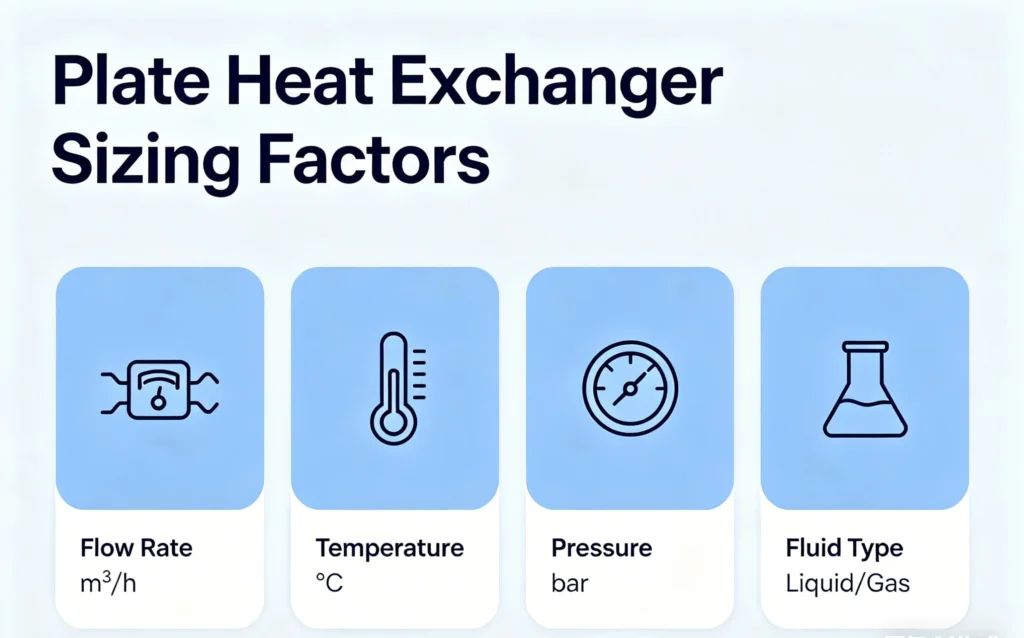
Several engineering factors determine the correct plate heat exchanger size.
Flow Rate Requirements
Flow rate directly affects heat transfer capacity. Higher flow rates generally require larger heat transfer areas and more plates.
Engineers usually calculate flow rate using:
- GPM (gallons per minute)
- m³/h (cubic meters per hour)
Inlet and Outlet Temperatures
Temperature difference plays a major role in sizing calculations. The greater the temperature difference, the easier heat transfer becomes.
Typical sizing calculations require:
- Hot fluid inlet temperature
- Hot fluid outlet temperature
- Cold fluid inlet temperature
- Cold fluid outlet temperature
Heat Load and BTU Capacity
Heat load is the amount of heat energy transferred by the system.
A basic formula used in heat exchanger calculations is:
Q=m×Cp×ΔT
Where:
- Q = Heat load
- m = Mass flow rate
- Cp = Specific heat
- ΔT = Temperature difference
Pressure Drop Considerations
Pressure drop is one of the most overlooked sizing factors.
Excessive pressure drop may:
- Reduce flow efficiency
- Increase pump energy consumption
- Damage system performance
Fluid Type and Viscosity
Different fluids transfer heat differently.
For example:
- Water transfers heat efficiently
- Oil requires larger surface areas
- Glycol mixtures increase pressure drop
Operating Pressure and Temperature Limits
High-pressure industrial systems often require thicker plates and stronger frame designs.
For corrosive environments such as seawater applications, titanium plates are commonly recommended.
📌 Suggested Image Placement
How to Select and Size a Heat Exchanger
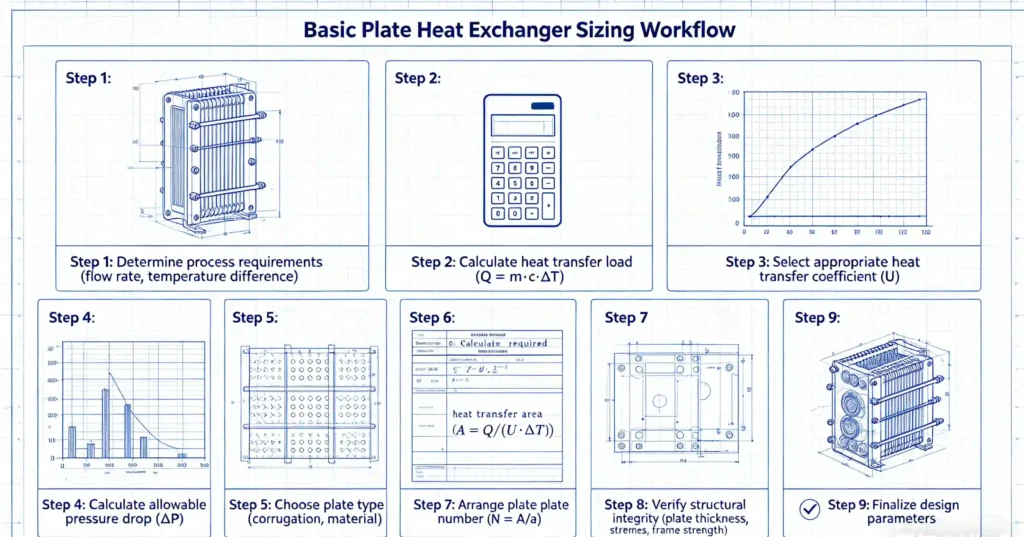
Proper sizing usually follows several engineering steps.
Step 1 – Determine Your Heat Transfer Duty
First, calculate the required heat load based on your application.
Example:
- Heating water
- Cooling oil
- Boiler separation
- HVAC temperature control
Step 2 – Calculate Required Flow Rate
The required flow rate determines how much fluid must pass through the exchanger.
Both hot and cold side flow rates should be calculated carefully.
Step 3 – Select the Appropriate Plate Material
Material selection depends on:
- Corrosion resistance
- Fluid compatibility
- Temperature requirements
Common materials include:
- 304 stainless steel
- 316 stainless steel
- Titanium
Step 4 – Estimate Heat Transfer Area
Larger heat loads require:
- More plates
- Larger plate surface areas
- Increased flow channels
Step 5 – Verify Pressure Drop Requirements
After estimating heat transfer area, engineers verify that pressure losses remain within acceptable limits.
📌 Suggested Image Placement
Basic plate heat exchanger sizing workflow diagram]
Plate Heat Exchanger Sizing Recommendations for HVAC Systems
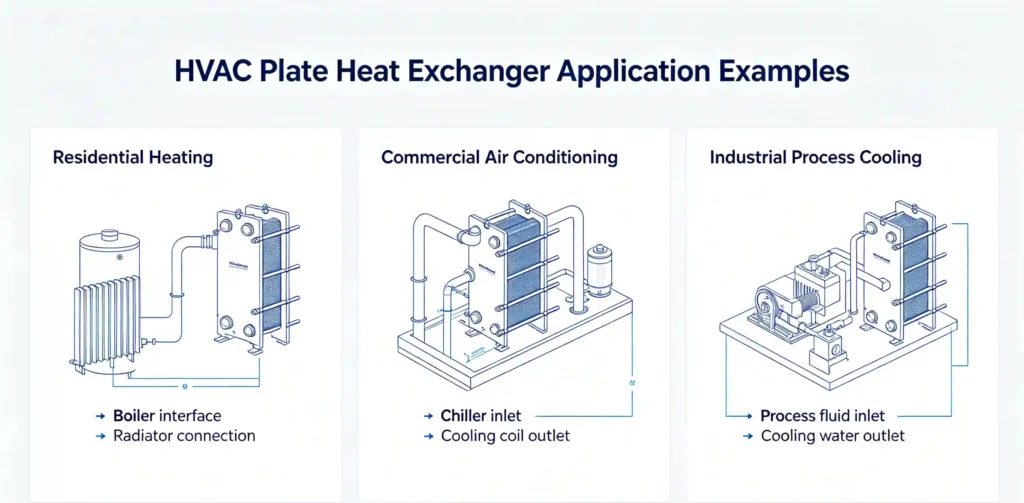
HVAC systems often require different sizing strategies depending on the application.
Residential Boiler Systems
Residential systems usually use compact brazed plate heat exchangers because they are:
- Small
- Efficient
- Cost-effective
Radiant Floor Heating Applications
Floor heating systems typically require stable low-temperature heat transfer with moderate flow rates.
Commercial HVAC Systems
Commercial buildings often use larger gasketed plate heat exchangers due to higher flow demands and easier maintenance access.
Chiller and Cooling Applications
Cooling systems generally require:
- Higher heat transfer efficiency
- Low pressure drop
- Stable temperature control
Domestic Hot Water Systems
Domestic hot water applications often use compact stainless steel BPHE units.
📌 Suggested Image Placement
HVAC plate heat exchanger application examples
How to Determine Length and Width of a Plate Heat Exchanger
Physical dimensions affect both performance and installation requirements.
How Plate Dimensions Affect Heat Transfer
Larger plates provide:
- More heat transfer surface area
- Higher thermal capacity
- Better efficiency
Relationship Between Plate Area and Capacity
As plate area increases:
- Heat transfer efficiency improves
- Capacity increases
- Flow distribution becomes more stable
How Number of Plates Impacts Size
More plates generally mean:
- Greater heat transfer area
- Higher thermal capacity
- Increased pressure drop
Compact vs Large Industrial Heat Exchangers
Compact units are ideal for:
- Residential systems
- Small HVAC systems
Large industrial units are better for:
- Chemical processing
- Food production
- Industrial cooling
What Size Brazed Plate Heat Exchanger Is Common?
Brazed plate heat exchangers are available in many sizes depending on the application.
Small Brazed Plate Heat Exchangers for Residential Use
Common for:
- Boilers
- Floor heating
- Domestic hot water
Usually:
- 10–30 plates
- Compact footprint
Medium-Sized Units for HVAC Systems
Common in:
- Commercial HVAC
- Chiller systems
- Heat pump applications
Large Brazed Plate Heat Exchangers for Industrial Applications
Industrial systems often require:
- Larger plate areas
- Higher flow rates
- Higher pressure ratings
Typical Plate Counts and Capacities
Typical ranges:
- Small systems: 10–20 plates
- Medium systems: 30–60 plates
- Large systems: 60+ plates
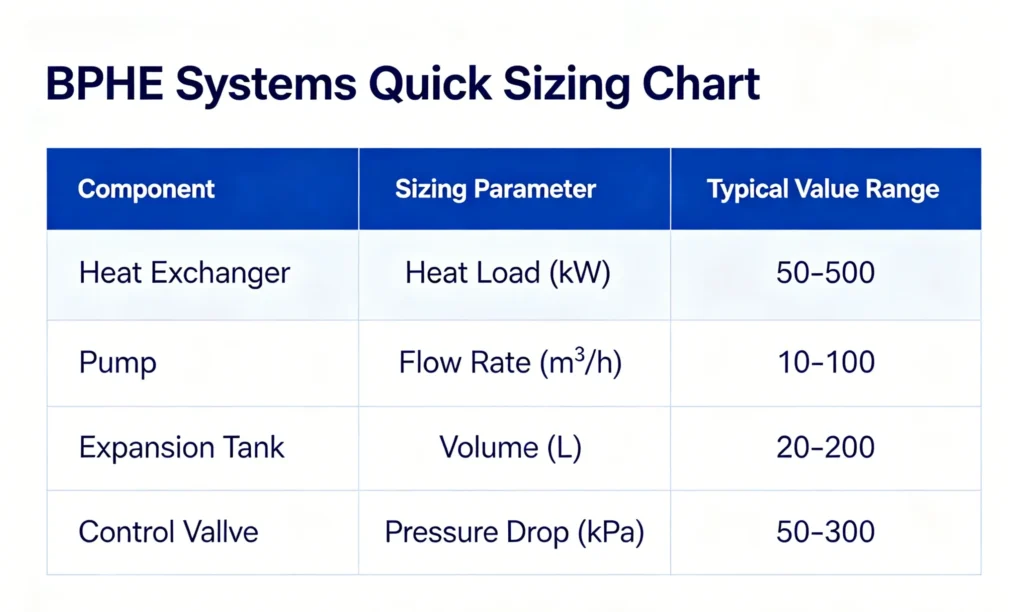
Quick Sizing Charts for Brazed Plate Heat Exchanger
Sizing charts provide a quick reference for estimating heat exchanger size.
Precision Temperature Control: How Plate Heat Exchangers Revolutionize Chemical Processing
| Application | Estimated Capacity |
| Floor Heating | Low |
| Domestic Hot Water | Medium |
| HVAC Cooling | Medium-High |
| Industrial Cooling | High |
Flow Rate Sizing Chart
| HVAC Application | Typical Heat Exchanger Type |
| Residential Boiler | Compact BPHE |
| Commercial HVAC | Gasketed PHE |
| Chiller System | High-Efficiency BPHE |
Recommended BPHE Sizes by Application
Different applications require different plate counts, flow channels, and pressure ratings.
📌 Suggested Image Placement
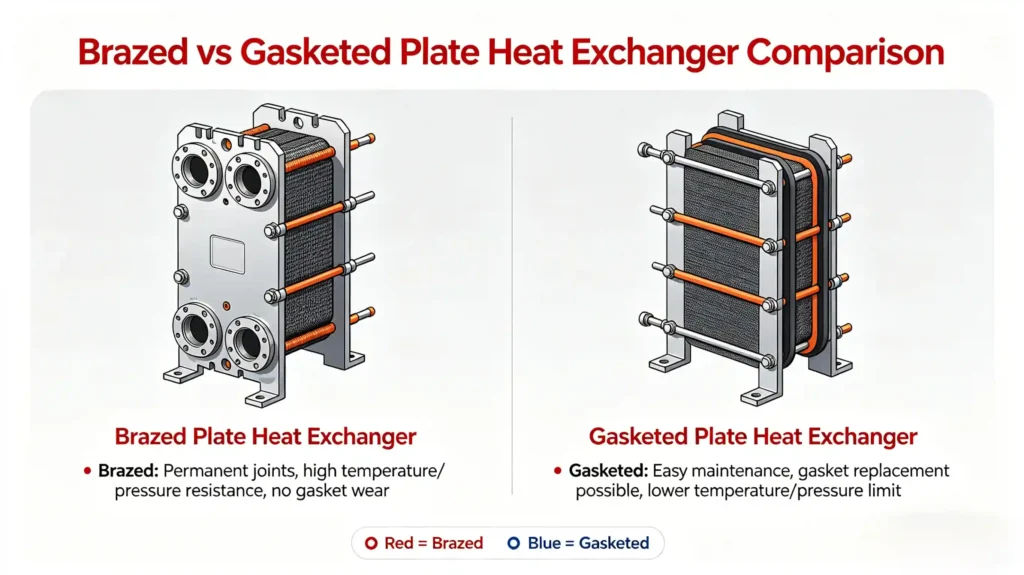
Brazed vs Gasketed Plate Heat Exchanger Sizing
Both types have different sizing characteristics.
Sizing Differences Between BPHE and GPHE
Brazed units:
- Compact
- High efficiency
- Fixed plate count
Gasketed units:
- Expandable
- Easier to clean
- Better for large industrial systems
When to Choose a Brazed Plate Heat Exchanger
Best for:
- HVAC
- Boilers
- Heat pumps
- Compact installations
When a Gasketed Heat Exchanger Is Better
Best for:
- Food processing
- Chemical industries
- Large flow systems
- Easy maintenance applications
📌 Suggested Image Placement
Common Mistakes When Sizing a Plate Heat Exchanger
Incorrect sizing often causes long-term system problems.
Ignoring Future Capacity Expansion
Systems often grow over time. Future expansion should always be considered during selection.
Choosing the Wrong Plate Material
Incorrect materials may lead to:
- Corrosion
- Leakage
- Short equipment life
Underestimating Pressure Drop
Pressure drop must remain within acceptable operating limits.
Using Incorrect Temperature Data
Small temperature calculation errors can significantly affect sizing accuracy.
Frequently Asked Questions About Plate Heat Exchanger Sizing
What size plate heat exchanger do I need for radiant floor heating?
Most residential radiant floor systems use compact brazed plate heat exchangers with low to medium flow capacity.
Can a plate heat exchanger be oversized?
Yes. Oversizing may reduce efficiency and increase system costs.
How many plates do I need?
The required number of plates depends on:
- Heat load
- Flow rate
- Temperature difference
- Fluid type
What is the ideal flow velocity?
Proper flow velocity helps maximize heat transfer while minimizing pressure drop.
How do I reduce pressure drop in a heat exchanger?
Pressure drop can be reduced by:
- Increasing plate area
- Using wider flow channels
- Optimizing flow rate
Conclusion
Selecting the correct plate heat exchanger size is one of the most important factors for improving system efficiency, thermal performance, and equipment lifespan. Proper sizing depends on flow rate, heat load, temperature difference, pressure drop, and fluid characteristics.
Whether you need a compact brazed plate heat exchanger for HVAC or a large gasketed unit for industrial applications, accurate sizing helps reduce energy consumption and improve long-term reliability.
If you need technical support for plate heat exchanger sizing, replacement plates, or gasket solutions, feel free to contact our team for professional assistance.
