
Selecting the right pharmaceutical plate heat exchanger requires more than choosing a model or estimating heat transfer area. Flow rates, inlet and outlet temperatures, process fluids, plate materials, gasket compatibility, and hygiene requirements all influence equipment performance and reliability.
Plate heat exchangers for pharmaceutical manufacturing are used for heating, cooling, and temperature control in pharmaceutical production, biotechnology processes, purified water systems, and supporting utilities.
Unlike standard industrial plate heat exchangers, equipment used in hygienic pharmaceutical processes may require special attention to drainability, cleanability, surface finish, and sterilization.
This guide explains the essential technical information buyers and engineers should prepare before selecting a pharmaceutical plate heat exchanger or requesting a quotation.
What Information Is Required to Size a Pharmaceutical Plate Heat Exchanger?
Accurate sizing begins with understanding the operating conditions of both fluids.
Before selecting a plate heat exchanger (PHE), the manufacturer typically needs the following information:
- Process fluids: Identify the heating and cooling media, including their physical and chemical properties.
- Operating temperatures: Provide the inlet and required outlet temperatures for both sides.
- Flow rates: Specify the mass flow rate or volumetric flow rate of each fluid.
- Operating pressure: Confirm normal operating pressure and required design pressure.
- Allowable pressure drop: Define the maximum acceptable pressure loss on each side.
- Material requirements: Specify preferred plate and gasket materials.
- Hygiene requirements: Identify any applicable cleanability, drainability, CIP, SIP, or surface-finish specifications.
The required configuration also depends on whether the exchanger handles direct product-contact fluids or non-product-contact utilities.
A sanitary plate heat exchanger used in a pharmaceutical process may require different construction and documentation from an industrial plate and frame heat exchanger used for facility cooling water.
Providing complete operating data helps plate heat exchanger manufacturers evaluate the thermal duty, suitable materials, and equipment configuration.
Hot Side and Cold Side: The 6 Essential Selection Parameters
The six primary thermal selection parameters consist of three values for each side of the heat exchanger.
| Parameter | Cold Side | Hot Side |
|---|---|---|
| Inlet Temperature (°C) | Required | Required |
| Outlet Temperature (°C) | Specify value | Specify value |
| Flow Rate (t/h) | Specify value | Specify value |
For straightforward single-phase liquid-to-liquid applications with known fluid properties, at least five of these six values are generally needed to determine the remaining value through an energy balance.
Both inlet temperatures should normally be specified. If the outlet temperature or flow rate on one side is unknown, it may be calculated from the other operating data, subject to appropriate engineering assumptions.
Heat transfer duty can be estimated using:
Q = m × Cp × ΔT
Where:
- Q: Heat transfer duty
- m: Mass flow rate
- Cp: Specific heat capacity
- ΔT: Temperature change
For example, consider a pharmaceutical process cooling application:
| Parameter | Hot Side | Cold Side |
|---|---|---|
| Fluid | Process Water | Cooling Water |
| Inlet Temperature | 80°C | 25°C |
| Outlet Temperature | 40°C | 35°C |
| Flow Rate | 5 t/h | To be calculated |
Assuming water properties remain approximately constant and heat losses are negligible, the required cooling-water flow rate is approximately 20 t/h.
This preliminary calculation establishes the thermal requirement. Final equipment sizing must also account for heat transfer coefficients, available temperature difference, fouling assumptions, and allowable pressure drop.
The six thermal parameters alone are not sufficient to finalize plate quantity or guarantee performance.
Selecting Plate Materials: Stainless Steel 316L, Titanium and Surface Finish
Plate material selection directly affects corrosion resistance, service life, cleaning compatibility, and suitability for pharmaceutical applications.
Stainless Steel 316L
Stainless steel 316L is widely considered for pharmaceutical process equipment because of its corrosion resistance, weldability, and suitability for many hygienic applications.
A stainless steel plate heat exchanger using 316L plates may be appropriate for certain purified water, pharmaceutical utility, and process cooling duties.
However, actual suitability depends on fluid composition, chloride concentration, operating temperature, and cleaning chemicals.
Stainless Steel 304
SS304 is commonly used in industrial heat transfer equipment and may be suitable for less demanding utility applications.
Compared with SS316L, it generally offers lower resistance to certain corrosive environments, particularly chloride-containing conditions.
Titanium Plates
Titanium plate heat exchangers may be considered for highly corrosive fluids, including certain seawater or chloride-rich applications.
For pharmaceutical facilities, titanium should be selected based on actual fluid compatibility rather than assumed to be necessary for every hygienic process.
Plate Surface Finish
Surface finish is another important consideration.
Electropolishing can improve the surface condition of stainless steel plates and support cleanability in suitable applications.
For hygienic plate heat exchangers, customers may need to specify surface roughness, cleaning requirements, and applicable inspection criteria.
Not every stainless steel plate heat exchanger requires electropolished plates. The appropriate finish should be determined by the process and hygiene specifications.
Choosing Gasket Materials for Sanitary Gasketed Plate Heat Exchangers
Gaskets provide sealing between individual heat transfer plates and help prevent leakage or unwanted fluid mixing.
In sanitary gasketed plate heat exchangers, gasket selection must consider more than operating temperature.
Important factors include:
- Compatibility with pharmaceutical process fluids
- Resistance to cleaning chemicals
- Continuous operating temperature
- Steam sterilization temperature and duration
- Compression performance and service life
- Applicable material and hygiene specifications
EPDM is commonly considered for water-based applications and certain cleaning or hot-water duties.
Silicone, including platinum-cured silicone, may be suitable for selected high-purity applications, depending on the formulation and operating conditions.
NBR is often used in compatible oil-related or industrial applications, although its temperature and chemical limitations must be evaluated.
Gasketed plate and frame heat exchangers offer the advantage of replaceable sealing components. Plates can be inspected, and compatible gaskets can be replaced during maintenance.
However, standard industrial gasket designs are not automatically suitable for direct pharmaceutical product contact.
Always verify gasket compatibility and any required supporting documentation before final selection.
Sanitary Plate Heat Exchanger Design: Drainability, Dead Zones and Cleanability
Hygienic design is one of the main differences between sanitary heat exchangers and conventional industrial plate heat exchanger units.
Three factors deserve particular attention.
1. Drainability
The internal flow channels should allow effective drainage wherever the application requires it.
Poor drainage can leave residual liquids inside the equipment, increasing cleaning difficulty and potential contamination risks.
Drainability depends on the exchanger design, connection arrangement, and installation orientation.
2. Dead Zones
Dead zones are areas with limited fluid circulation where material may accumulate.
Appropriate flow-channel design can help minimize stagnant regions and improve cleaning effectiveness.
3. Cleanability
For pharmaceutical processing, equipment should support the cleaning procedures required by the facility.
Plate surface finish, gasket geometry, connection design, and fluid distribution all influence cleanability.
A sanitary plate and frame heat exchanger must be evaluated as a complete assembly rather than judged only by the material of its stainless steel plates.
For critical hygienic applications, cleaning performance and design suitability may require documented verification.
CIP and SIP Requirements for Hygienic Plate Heat Exchangers
Cleaning-in-place (CIP) and sterilization-in-place (SIP) are important considerations when selecting heat exchangers for hygienic use.
Cleaning-in-Place (CIP)
CIP allows equipment to be cleaned through a controlled cleaning cycle without complete disassembly.
A typical process may involve rinsing, chemical cleaning, intermediate rinsing, and final rinsing.
Effective CIP depends on:
- Appropriate cleaning-fluid velocity
- Compatible cleaning chemicals
- Suitable cleaning temperature
- Adequate circulation time
- Effective removal of cleaning residues
The actual procedure depends on the process and facility requirements.
Sterilization-in-Place (SIP)
SIP may use pure steam to sterilize equipment exposed to pharmaceutical process conditions.
Sterilization temperatures can reach approximately 121°C or higher, depending on the validated process.
Both plates and gaskets must tolerate the specified temperature, pressure, exposure duration, and repeated sterilization cycles.
A material’s maximum temperature rating does not automatically confirm its suitability for SIP.
For pharmaceutical and biotechnology applications, the complete exchanger configuration should be reviewed against the intended cleaning and sterilization procedures.
Pressure Drop, Design Pressure and Connection Selection
Thermal performance alone does not determine whether a plate heat exchanger is suitable for a particular installation.
Pressure drop represents the pressure loss as fluid passes through the exchanger.
Higher fluid velocity can improve heat transfer but may also increase pressure drop and pumping requirements.
A manufacturer must balance thermal performance, pumping energy, and allowable pressure loss when selecting plate geometry and the number of flow channels.
Design pressure is another essential parameter.
The selected frame, plates, gaskets, and connections must be rated for the specified mechanical design conditions.
Pressure requirements should be assessed independently from ordinary operating pressure.
Connection selection also affects installation and hygienic suitability.
Customers should specify connection size, type, location, and any required sanitary connection standards.
For pharmaceutical applications, connection materials, drainage arrangements, and cleanability may be particularly important.
These details help determine whether a proposed PHE configuration fits the available process piping and operating requirements.
How to Request a Pharmaceutical Plate Heat Exchanger Quotation from Senovis PHE
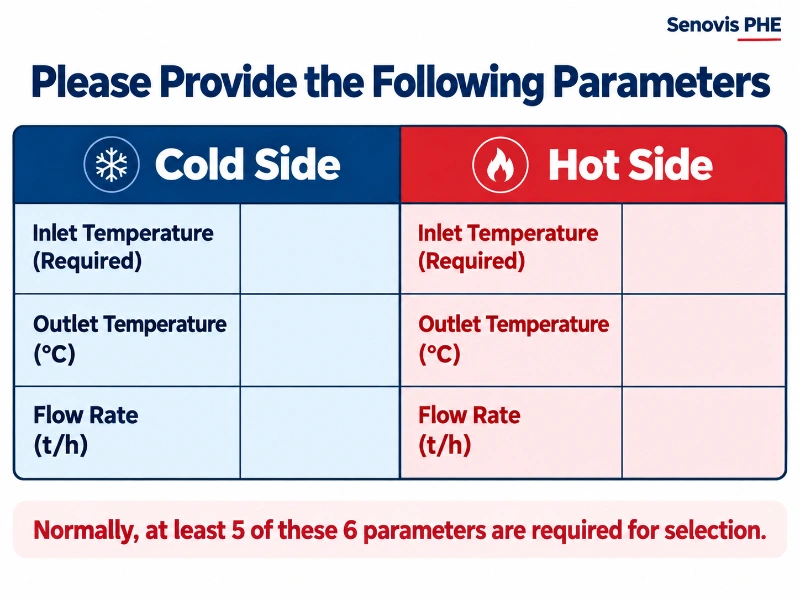
A complete request for quotation (RFQ) helps suppliers evaluate thermal performance, materials, and equipment compatibility more accurately.
When contacting Senovis PHE, customers should provide the following information whenever available:
- Application and process-fluid details
- Hot-side inlet and outlet temperatures
- Cold-side inlet and outlet temperatures
- Hot-side and cold-side flow rates
- Operating and design pressures
- Maximum allowable pressure drops
- Required plate and gasket materials
- CIP, SIP, and hygiene specifications
- Connection sizes and installation requirements
- Required technical documentation and delivery destination
For replacement projects, please also provide the existing equipment brand, model, nameplate, plate dimensions, or gasket photographs.
About Senovis PHE
Senovis (Beijing) Technology Co., Ltd. (Senovis PHE) supplies gasketed plate heat exchangers (GPHE), compatible replacement plates, and sealing gaskets for industrial heat transfer applications.
As a plate heat exchanger supplier, Senovis PHE supports customers seeking complete heat exchanger units, replacement components, and technical product matching.
Our replacement range includes compatible parts for selected models associated with Alfa Laval, GEA/Kelvion, APV, Sondex/Danfoss, Tranter, Funke, and other manufacturers.
These compatible replacement products are aftermarket components rather than original OEM parts.
For pharmaceutical manufacturing projects, the required sanitary design, material specifications, and cleaning or sterilization suitability must be confirmed before an equipment configuration is approved.
Explore our gasketed plate heat exchanger solutions:
https://pheheat.com/collections/gasketed-plate-heat-exchanger
Contact Senovis PHE
Email: sales@PHEheat.com
WhatsApp: +86 15094396595
Website: https://www.pheheat.com/
Send us your operating parameters and technical requirements to discuss a suitable plate heat exchanger selection or replacement solution.
